
Whether you are upgrading your home’s curb appeal or replacing a damaged unit, buying a new garage door is a major investment. But before you can choose the right style, material, or insulation rating, you need to get the exact dimensions.
A perfectly measured door ensures a smooth installation, operates safely, and provides a tight weather seal—especially important when you want to keep out those freezing Indiana winter drafts.
Grab a steel tape measure, a step ladder, and a notepad. Here is the step-by-step process to measure your garage to ensure your new door fits perfectly.
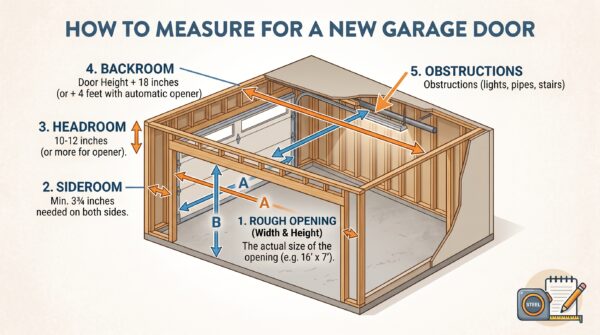
Step 1: Measure the Rough Opening (Width and Height)
This is the actual size of the hole in the wall where the door will go.
- Width: Measure the distance from the inside of the right side jamb to the inside of the left side jamb at the widest point.
- Height: Measure the distance from the floor to the bottom of the header (the top of the door opening). Make sure the floor is relatively level; if it’s uneven, take note, as you may need a specialized bottom seal or minor concrete leveling.
Pro Tip: The rough opening should match the exact size of the door you plan to buy. If your rough opening is 16 feet wide by 7 feet tall, you need a 16×7 garage door.
Step 2: Measure the Sideroom
Sideroom is the space on the wall next to the left and right sides of the garage door opening. You need this space to install the vertical tracks.
- Measure from the edge of the opening out to the nearest wall or obstruction (like shelving or electrical panels) on both the left and right sides.
- Standard Requirement: You generally need at least 3 ¾ inches on each side for standard extension or torsion springs. If you are installing a larger commercial door or a heavy-duty track, you may need up to 4 ½ inches or more.
Step 3: Measure the Headroom
Headroom is the distance between the top of the door opening (the header) and the ceiling (or the lowest hanging obstruction, like a light fixture or ductwork). This space is crucial for the overhead tracks and the spring system.
- Measure from the top of the door opening straight up to the ceiling.
- Standard Requirement: You typically need between 10 to 12 inches of headroom for a standard torsion spring system. If you are adding an automatic garage door opener, you will usually need an additional 3 to 4 inches (15 inches total).
- Note: If you have low headroom, don’t worry. Specialized low-headroom tracks can be installed, though it’s important to know this before ordering.
Step 4: Measure the Backroom
Backroom is the distance from the garage door opening straight back to the rear wall of the garage. The door needs room to retract fully when open.
- Measure from the header to the back wall or the nearest obstruction on the ceiling.
- Standard Requirement: You need the height of the garage door plus at least 18 inches. If you are installing an automatic opener, you will generally need the door height plus 4 feet (e.g., a 7-foot door requires 11 feet of backroom).
Double-Check for Obstructions
Before finalizing your numbers, take a quick look around the interior of your garage. Check for any hazards or obstructions that might interfere with the tracks or the door itself, including:
- Electrical outlets or conduit
- Lighting fixtures
- Attic access stairs
- Pipes and HVAC ductwork
Ready for Your New Door?
Taking accurate measurements is the most critical step in ordering a new garage door. A precise fit guarantees better security, enhanced energy efficiency, and a longer lifespan for your opener.
Once you have your dimensions jotted down, you are ready to shop with confidence. If you run into any tricky measurements or just want an expert set of eyes on your project, reach out to our team. We can help you verify your specs and find the perfect door to elevate your property.